Framework Purpose
CLEAR Logic helps finance teams clarify a process before a business rule becomes part of an automated or AI-assisted workflow.
What the Framework Is
CLEAR Logic is a review sequence informed by Valentina DuPont’s CPA perspective. It helps finance and cross-functional teams make the business knowledge surrounding a rule visible before that rule becomes part of an automated or AI-assisted workflow. It is not a programming methodology and does not replace formal implementation, security, legal, accounting, audit, or control standards.
Framework Figure
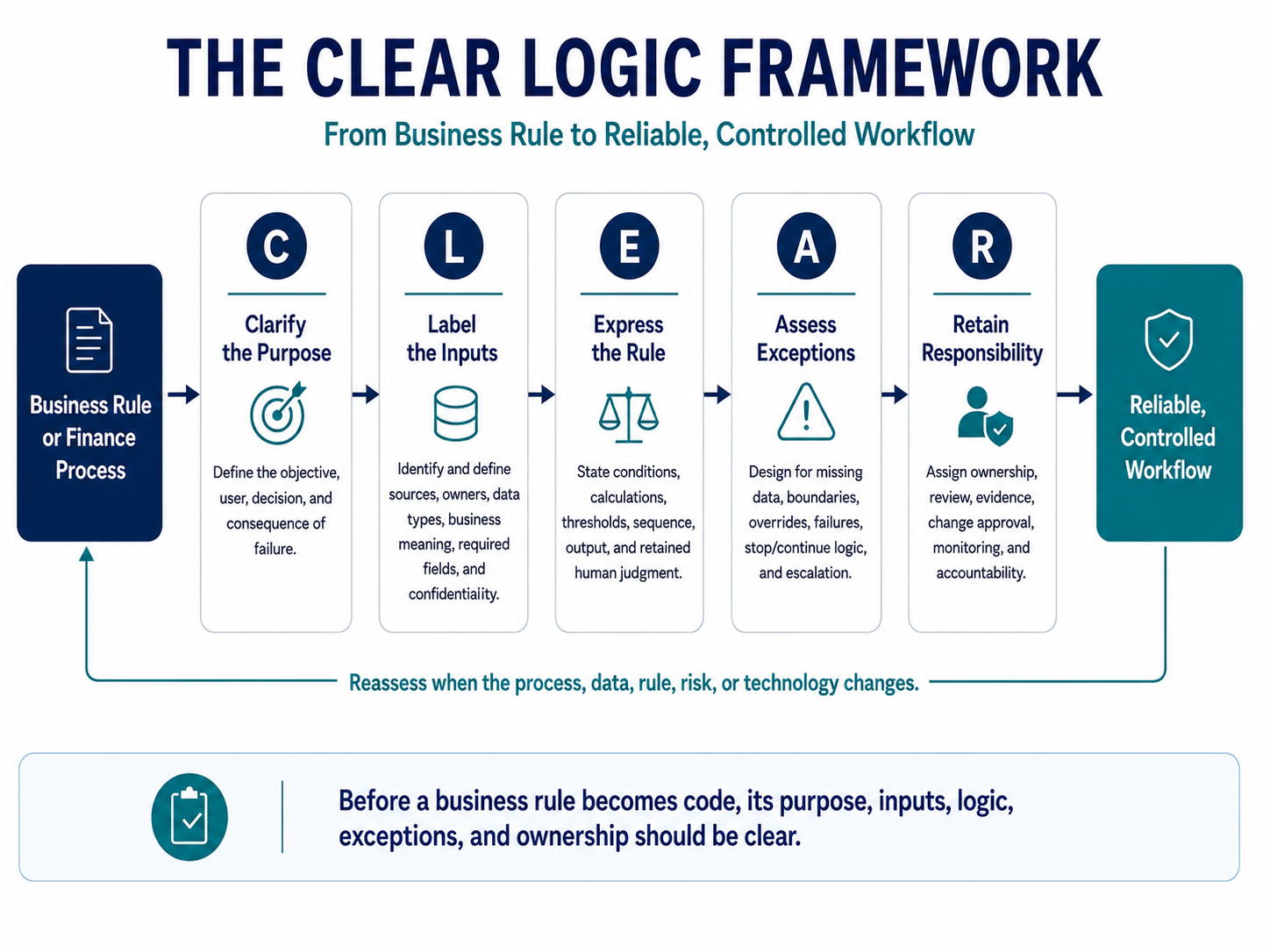
The Five CLEAR Stages
C — Clarify the Purpose
Definition: Define the objective, intended user, decision supported, and consequence of failure.
Core questions: What is this process meant to accomplish? Who relies on the result? What happens if it is wrong?
L — Label the Inputs
Definition: Identify and define sources, owners, data types, business meaning, required fields, and confidentiality.
Core questions: What enters the process? Where does it come from? How is it defined and validated?
E — Express the Rule
Definition: State conditions, calculations, thresholds, sequence, expected output, and retained human judgment.
Core questions: What exact logic applies? Which rule takes priority? What result should be produced?
A — Assess Exceptions
Definition: Design for missing data, boundaries, overrides, failures, stop/continue logic, and escalation.
Core questions: What happens outside the normal path? When should the process stop, continue, or escalate?
R — Retain Responsibility
Definition: Assign ownership, review, evidence, change approval, monitoring, and accountability.
Core questions: Who owns the rule? Who approves changes? How is performance monitored and evidence retained?
How to Use the Framework
Define the business rule or finance process being considered.
Work through CLEAR in order, documenting uncertainty rather than resolving it informally.
Identify the evidence, approvals, exception paths, and human judgment required for the intended use.
Use Practice Guide No. 002 for the detailed readiness assessment.
Reassess the workflow when the process, data, rule, risk, technology, or organizational requirements change.
Illustrative Accounting Application
Suppose a finance team wants to automate a monthly expense-variance flag. CLEAR prevents the team from treating a threshold formula as the entire control.
- C — Clarify: The objective is to identify accounts requiring investigation, not to explain or approve the variance automatically.
- L — Label: Define the current amount, comparison amount, account, entity, period, approved thresholds, data source, and owner.
- E — Express: Flag an account only when the dollar and percentage thresholds are both exceeded, using the approved comparison basis.
- A — Assess: Address new accounts, zero prior-period balances, reclassifications, acquisitions, missing data, and unusual transactions.
- R — Retain: Assign the investigator, reviewer, evidence requirement, threshold-change approver, and periodic monitoring owner.
Signs a Process Is Not Ready
- Different employees apply the same rule differently.
- Inputs are not defined, owned, reconciled, or consistently classified.
- Thresholds or assumptions exist without approval or an effective date.
- Exceptions are handled through memory, email, or informal workarounds.
- The output can be produced but not independently explained or validated.
- No one owns monitoring, changes, evidence, or the consequence of error.
Closing Principle
Before a business rule becomes code, its purpose, inputs, logic, exceptions, and ownership should be clear.
Framework Limits
CLEAR Logic is a business-rule review aid. It does not establish whether automation is legally permissible, technically secure, compliant with professional standards, or appropriate for every use. Higher-risk processes require deeper technical, legal, security, privacy, accounting, audit, risk, and governance review.
Related Knowledge Hub Materials
Learning note
This framework reflects Valentina DuPont’s personal understanding and practical interpretation of concepts explored through professional education and experience in accounting and finance. It is intended for general educational purposes and is not accounting, legal, audit, tax, technology, cybersecurity, or other professional advice. Organizational facts, risks, policies, and applicable standards should determine the appropriate review.