Core Principle
A modeled recommendation is ready for reliance only when the organization can connect it to evidence, constraints, authority, and monitoring. The calculation may come from Python; accountability does not.
Purpose
Simulation and optimization can organize uncertainty and compare feasible choices. The Decision Reliance Framework helps accounting, finance, technical teams, operations, and leadership determine whether a modeled recommendation is relevant, supportable, and ready for authorized action.
Framework Figure
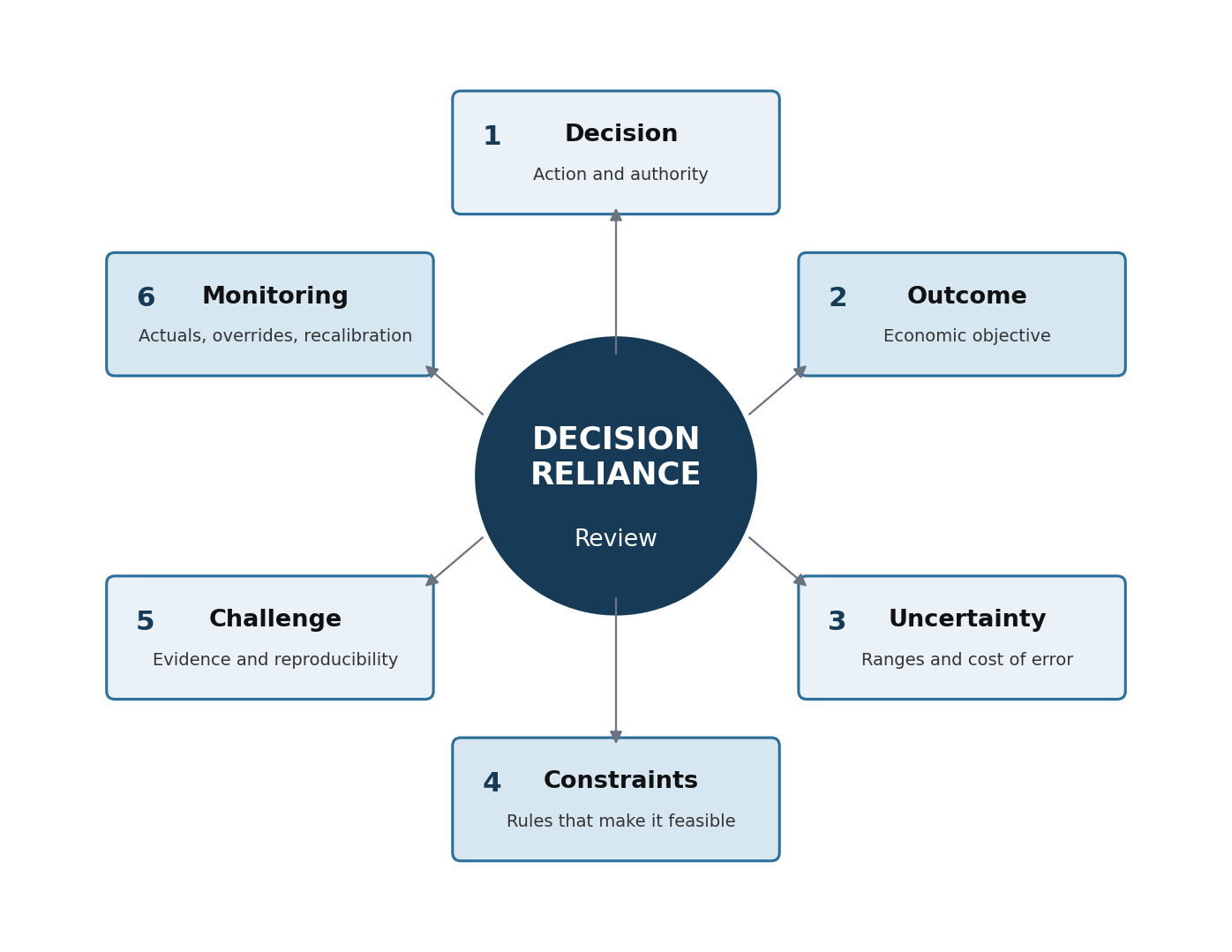
The six questions
Decision
Question: What action is being considered, when must it be made, and who has authority to approve it?
Review focus: Action, timing, scope, approving authority, and implementation ownership.
Outcome
Question: What economic outcome is the model trying to improve, and what does it reward or ignore?
Review focus: Economic objective, measurement basis, unintended incentives, and omitted considerations.
Uncertainty
Question: Which variables can change, how are their ranges or distributions supported, and what is the cost of being wrong in each direction?
Review focus: Supported ranges, distributions, dependencies, sensitivity, and asymmetric error costs.
Constraints
Question: Which budgets, capacities, deadlines, contracts, reserves, policies, and operating rules make the recommendation feasible?
Review focus: Funding limits, capacity, contract terms, timing limits, reserves, policies, and operating feasibility.
Challenge
Question: Can another reviewer trace the data, reproduce the result, test changed assumptions, and understand why the optimizer completed successfully?
Review focus: Data lineage, assumptions, code version, random seed where relevant, sensitivity results, and independent review.
Monitoring
Question: How will the organization compare expected and actual results, investigate exceptions, approve overrides, and decide when to recalibrate or suspend use?
Review focus: Performance monitoring, exception handling, overrides, recalibration, suspension, and accountability.
How to use the framework
- Begin with the decision. Do not start with the model or available data. Identify the action, timing, level of detail, and accountable decision owner.
- Translate the objective into economic terms. State the outcome the model should improve and identify important considerations that must remain outside the optimizer as constraints, approvals, or human judgment.
- Make uncertainty explicit. Document the variables that can change, the evidence for their ranges, the relationships among them, and the consequences of error.
- Encode only supported constraints. Confirm that legal, contractual, operational, funding, timing, safety, and policy limits reflect the real organization.
- Require challenge before reliance. Retain the source data, assumptions, code version, random seed where relevant, completion checks, sensitivity results, and independent review evidence.
- Monitor the action. Compare actual results with the modeled expectation, investigate exceptions, document overrides, and define when continued reliance is no longer appropriate.
Where it can apply
| Application | What the framework helps reviewers examine |
|---|---|
| Cash and liquidity | Funding priorities, minimum balances, transfer restrictions, borrowing cost, timing risk, and authority to move funds. |
| Budget allocation | Diminishing returns, competing priorities, spending limits, service commitments, and the effect of a changed budget. |
| Staffing | Demand uncertainty, unequal overstaffing and understaffing costs, service levels, and operational feasibility. |
| Capital planning | Timing, downside exposure, capacity, financing, contractual commitments, and the value of preserving options. |
| Portfolio decisions | Expected return, volatility, relationships among holdings, allocation limits, changing assumptions, and risk ownership. |
Roles and accountability
Accounting and finance help define the economic outcome, cost of error, evidence, data cutoff, and financial constraints. Model builders explain how uncertainty and optimization were implemented. Operations validates feasibility. Other specialists validate requirements within their expertise. Leadership and designated decision owners approve the objective, risk appetite, permitted use, and action.
Accessible figure text
The framework asks six questions before an organization relies on a modeled recommendation: Decision, Outcome, Uncertainty, Constraints, Challenge, and Monitoring.
Decision defines the action, timing, scope, and approving authority. Outcome states the economic objective and what the model rewards or ignores. Uncertainty documents variables that can change, supporting evidence, dependencies, and the cost of error. Constraints confirm budgets, capacities, deadlines, contracts, reserves, policies, and operating rules. Challenge retains evidence required to trace, reproduce, and test the result. Monitoring compares expected and actual results, investigates exceptions, approves overrides, and defines when to recalibrate or suspend use.
Related Knowledge Hub Materials
Learning note and disclaimer
This framework is Valentina DuPont's original professional interpretation of simulation, optimization, and governance concepts. It is educational and does not provide accounting, investment, legal, tax, technology, energy, lending, or model-risk advice. Organizations should involve qualified professionals and evaluate applicable requirements before using modeled recommendations in consequential decisions.