Core Principle
A modeled recommendation is ready for reliance only when the organization can connect it to evidence, constraints, authority, and monitoring. The calculation may come from Python; accountability does not.
Purpose
Use this guide to connect a modeled recommendation to the decision it supports, the economics it represents, the constraints that make it feasible, the evidence required for reliance, and the people authorized to act.
Intended users
- Accounting and finance professionals reviewing modeled recommendations.
- Controllers, treasury teams, analysts, and finance leaders.
- Model builders preparing an analysis for business review.
- Operations and leadership responsible for feasibility and authorization.
When to use it
- Before approving or relying on a simulation or optimization result.
- When assumptions, constraints, or available resources change materially.
- After significant exceptions, override patterns, or monitoring issues arise.
- When a model-supported recommendation may influence a financial or operating decision.
What the guide contains
Decision and authority
Clarify the action, decision date, period affected, scope, approving authority, and implementation ownership.
Economic outcome
Define the objective, success measure, assumptions, omitted considerations, and business consequence of being wrong.
Uncertainty and evidence
Document variables that can change, supported ranges, dependencies, data sources, and sensitivity results.
Constraints and feasibility
Confirm the budgets, capacities, deadlines, contracts, reserves, policies, and operating rules that make a recommendation usable.
Challenge and reproducibility
Retain data, assumptions, code version, random seed where relevant, completion checks, independent review, and challenge evidence.
Monitoring and accountability
Compare expected and actual results, investigate exceptions, approve overrides, and define when to recalibrate or suspend use.
Framework summary
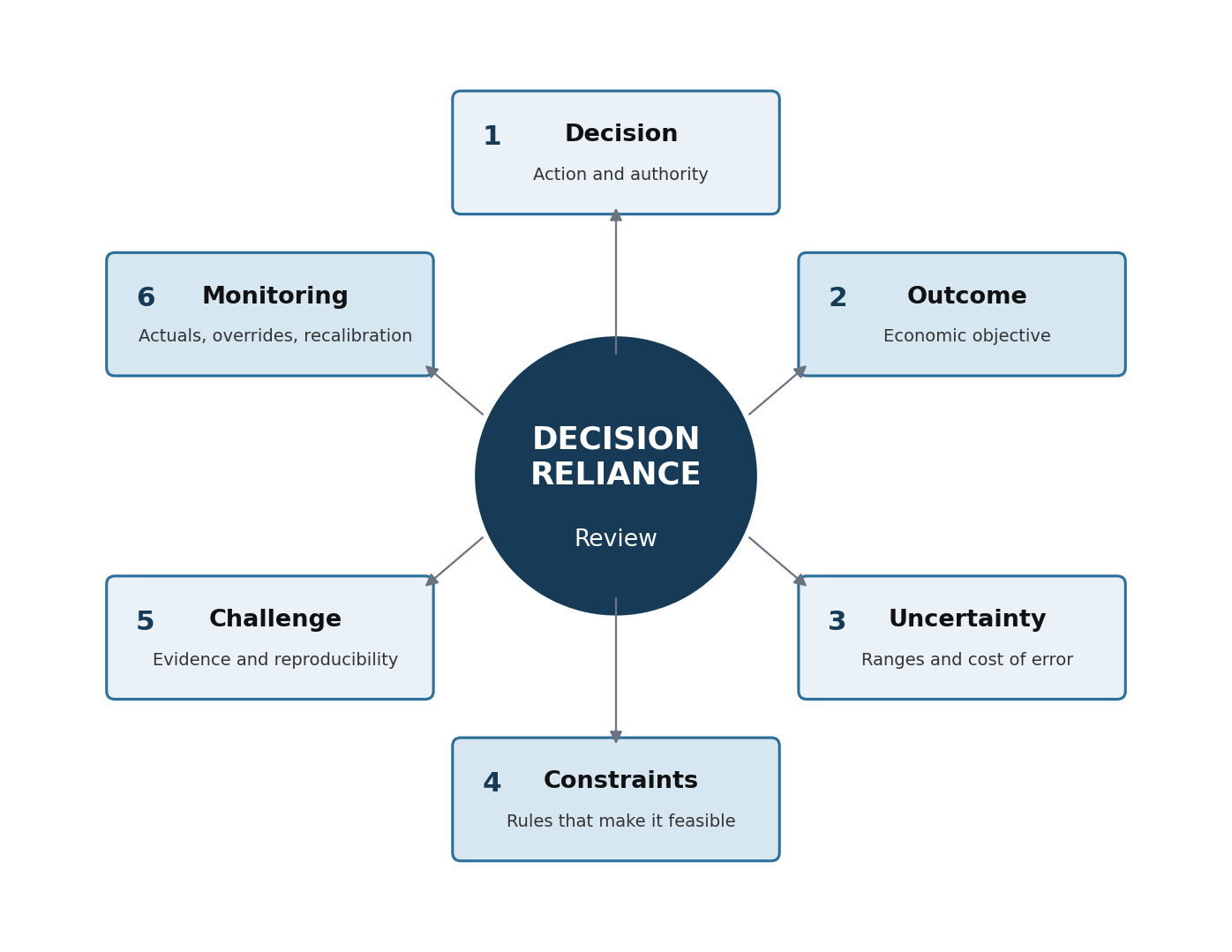
Decision
Define the action, timing, scope, and approving authority.
Outcome
State the economic objective and what the model rewards or ignores.
Uncertainty
Document the variables that can change, supporting evidence, dependencies, and cost of error.
Constraints
Confirm the budgets, capacities, deadlines, contracts, reserves, policies, and operating rules that make the recommendation feasible.
Challenge
Retain the evidence required to trace, reproduce, and test the result.
Monitoring
Compare expected and actual results, investigate exceptions, approve overrides, and define when to recalibrate or suspend use.
Connected learning experience
Read the article to understand the idea. Explore the framework to organize your thinking. Apply the Practice Guide in real finance and accounting work.
Learning note and disclaimer
This guide reflects Valentina DuPont's personal learning and professional interpretation of simulation, optimization, and governance concepts. It is an original educational resource and does not reproduce course slides, code, datasets, transcripts, prompts, or proprietary instructional language. It is not accounting, investment, legal, tax, technology, energy, lending, or model-risk advice and does not represent the views of any educational institution, employer, regulator, or professional association.