Core Principle
A more accurate model earns organizational reliance only when its improvement is material, its information is timely, and its output supports an accountable decision.
Purpose
This framework helps finance, accounting, leadership, and model teams evaluate whether a model's reported improvement is ready to influence a consequential decision. It separates predictive performance from organizational authorization. A higher score begins the review; it does not end it.
Framework Figure
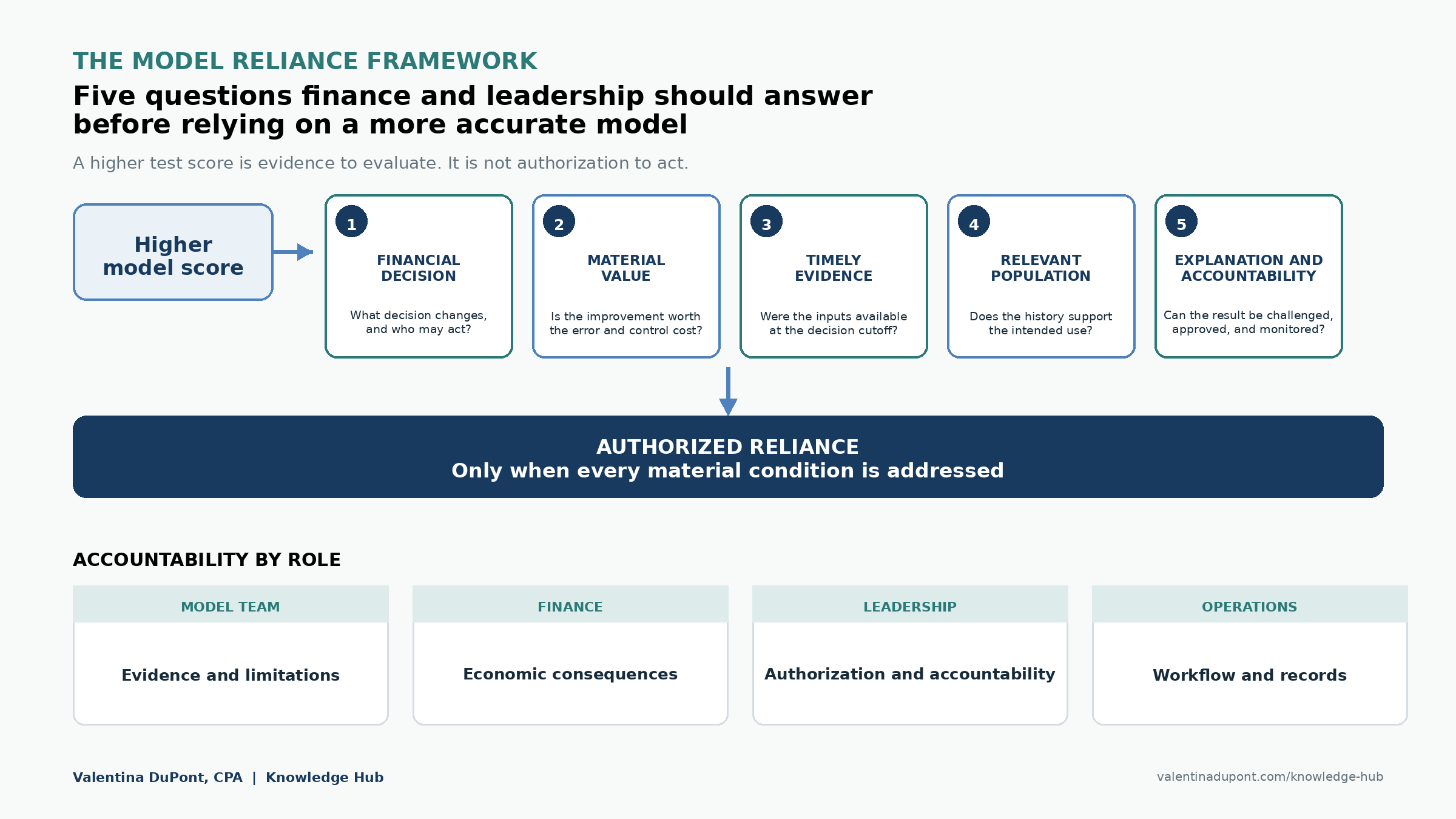
The five reliance questions
Financial decision
Question: What decision changes, and who may act?
Evidence to examine: Target, horizon, user, decision owner, authorized action
Material value
Question: Is the improvement worth the remaining error and added control cost?
Evidence to examine: Baseline comparison, error cost, liquidity effect, implementation and monitoring cost
Timely evidence
Question: Were the inputs available at the decision cutoff?
Evidence to examine: As-of dates, source lineage, delayed fields, substitutions, reconciliations
Relevant population
Question: Does the historical population support the intended use?
Evidence to examine: Included and excluded cases, prior approvals, changing conditions, current-use population
Explanation and accountability
Question: Can the result be challenged, approved, and monitored?
Evidence to examine: Drivers, limits, owners, approval rights, overrides, monitoring and stop conditions
How to use the framework
- Begin with the decision. State the financial outcome, forecast horizon, user, and authorized action before comparing models.
- Test the claimed improvement. Compare the model with a simpler baseline on unseen data and translate the difference into financial consequences.
- Reconstruct the decision date. Remove information that would not have been available by the cutoff and reevaluate performance.
- Challenge the population and explanation. Identify selection effects, changing conditions, important drivers, and the limits of interpretation.
- Allocate authority before use. Document who provides evidence, who challenges it, who approves reliance, and who monitors outcomes.
Responsibility for reliance
| Role | Primary responsibility | Evidence of completion |
|---|---|---|
| Model team | Explain the data, model design, testing, tuning, assumptions, limitations, and failure conditions. | Technical documentation, validation results, lineage, limitations |
| Finance | Challenge the evidence and connect forecast error to cash, liquidity, reporting, risk, and control consequences. | Business interpretation, reconciliations, materiality and error analysis |
| Leadership | Approve acceptable error, authorized use, decision rights, and accountability for actions. | Approval, constraints, accepted residual risk, review date |
| Operations | Confirm workflow timing, user responsibilities, exceptions, records, and practical execution. | Procedures, training, override and exception records, fallback process |
When reliance should pause
Pause and remediate when the improvement disappears under realistic timing constraints, the population does not support the intended use, the result cannot be explained at the level the decision requires, or no authorized owner accepts responsibility for the action and continuing monitoring.
Accessible figure text
The framework starts with a higher model score and tests whether reliance is authorized through five questions: Financial decision; Material value; Timely evidence; Relevant population; and Explanation and accountability.
Model teams, finance, leadership, and operations each hold separate responsibilities for evidence, challenge, approval, workflow, and records.
Related Knowledge Hub Materials
Learning note and disclaimer
This framework reflects Valentina DuPont's personal learning and professional interpretation of advanced predictive analytics concepts. It is an original educational resource and does not reproduce course slides, code, datasets, transcripts, prompts, or proprietary instructional language. It is not accounting, investment, lending, legal, statistical, or model-risk advice and does not represent the views of any educational institution, employer, regulator, or professional association.