Purpose
Use this guide before relying on AI-assisted research, document review, financial analysis, reporting, or decision support. The depth of review should rise with the consequence of the decision.
Framework Context
As I reflected on what had changed in my thinking, I began organizing my questions into what I now call the CPA Lens for AI.
It is not a formal accounting standard or a substitute for an organization’s policies, legal guidance, internal controls, or technical review.
Before relying on an AI-generated analysis, summary, recommendation, or conclusion, I ask five questions.
Framework Figure
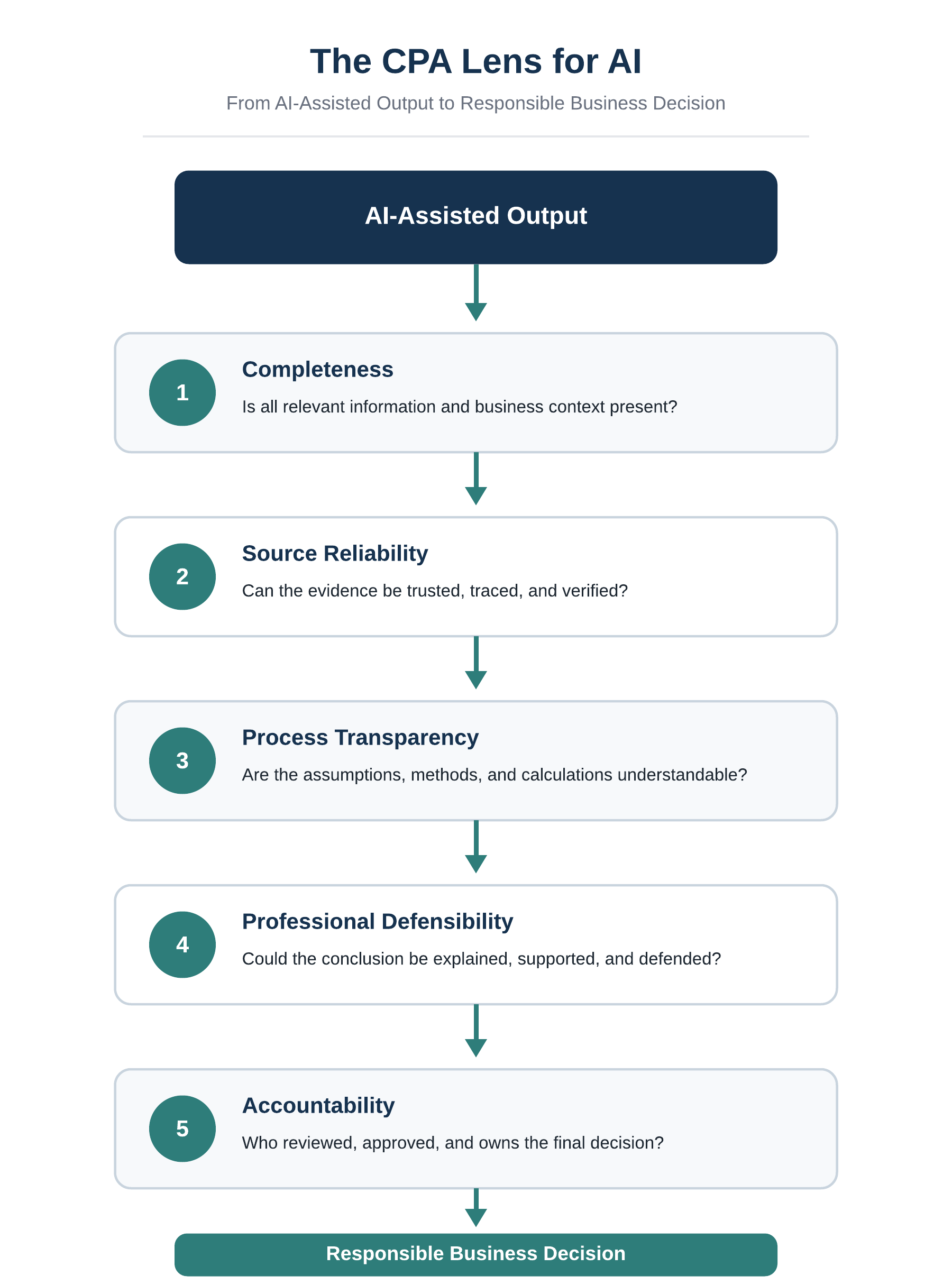
The Five Questions
Completeness
Question: Is all relevant information and business context present?
- The correct period, population, and scope are included.
- Relevant amendments, exceptions, reversals, and unusual items are included.
- Missing information and unresolved gaps are identified.
- The AI received enough context to address the actual business question.
Source Reliability
Question: Can the evidence be trusted, traced, and verified?
- Sources are current, authoritative, relevant, and appropriate.
- Material conclusions can be traced to source records or documents.
- Primary evidence is distinguished from commentary or inference.
- Confidential or restricted information was handled through an approved process.
Process Transparency
Question: Are the assumptions, methods, and calculations understandable?
- The population, methodology, and business rules are documented.
- Assumptions, classifications, exclusions, and estimates are visible.
- Material calculations can be independently recreated.
- Changes to data or documents were authorized and retained.
Professional Defensibility
Question: Could the conclusion be explained, supported, and defended?
- The conclusion follows from the evidence and business context.
- Limitations, uncertainty, and contradictory evidence are disclosed.
- The level of review is proportionate to the consequence of the decision.
- A qualified reviewer could explain the conclusion to leadership, auditors, or an audit committee.
Accountability
Question: Who reviewed, approved, and owns the final decision?
- A qualified person reviewed the work.
- Approval authority is appropriate for the risk and significance.
- The final decision owner is clearly identified.
- Responsibility was not delegated to the AI tool or vendor.
How to Use the Framework
1. Define the purpose and risk
What decision, task, or communication will this AI-assisted work support?
- Business purpose and intended use
- Potential consequence if the output is wrong or incomplete
- Evidence needed before reliance
2. Apply the CPA Lens
Review completeness, source reliability, process transparency, professional defensibility, and accountability.
3. Document findings and required corrections
Identify unresolved gaps, evidence needs, limitations, corrections, and follow-up actions before relying on the output.
4. Determine final disposition
- Not ready for reliance
- Additional evidence required
- Ready with documented limitations
- Approved for intended use
5. Create a decision record
Decision owner, reviewer approval, date, and follow-up actions.
Core Principle
AI may participate in the process. Responsibility for the outcome remains human.
Related Resources
Professional Disclaimer
This guide is an original educational resource in the Valentina DuPont, CPA Practice Series. It is not a substitute for professional standards, organizational policies, legal advice, technical accounting guidance, or formal internal-control procedures. Facts, circumstances, and risk levels should determine the appropriate review.