Central Idea
AI can help us become better accountants by giving us more time to apply our judgment where it matters most.
I remember finishing the first week of Columbia Business School’s AI for Business & Finance program and realizing that I was no longer afraid of artificial intelligence in the same way.
Before starting the program, I carried a concern that many accounting and finance professionals probably share: Could AI eventually replace much of what we do?
At the time, that concern felt entirely reasonable.
AI could already write, summarize, research, analyze documents, work with spreadsheets, generate presentations, and produce answers that sounded remarkably polished. As its capabilities expanded, it was natural to wonder where professionals like me would fit.
I enrolled expecting to learn practical AI tools, prompting techniques, automation, and perhaps some basic coding. I thought the program would help me use emerging technology more effectively in business.
I did not expect it to change how I thought about being a CPA.
By the end of the first week, I realized that I had been asking the wrong question.
The most useful question was not whether AI would replace accountants. It was: How can AI help accountants spend more time applying judgment where it matters most?
That shift - from fear to possibility - became the most meaningful lesson of the week.
It replaced my concern that AI might make accountants less valuable with a new understanding:
AI can help us become better accountants by giving us more time to apply our judgment where it matters most.
Everything else I learned during the week began to support that idea.
Learning how AI works changed how I listened to it
One of the most surprising moments for me was learning, at a high level, how large language models generate responses.
An AI model does not “know” an answer in the same way a qualified professional knows something through education, evidence, experience, and judgment. At a high level, language models process text as tokens and generate responses by predicting likely next tokens based on patterns learned during training and the context they have been given. [1]
That explanation changed the way I experienced AI.
When I first understood that the model was predicting what should come next rather than independently verifying the truth of each statement, I immediately thought about audit evidence.
A response could sound convincing and still require verification.
That realization stayed with me for the rest of the week.
Before, it was easy to read a sophisticated response and feel as though the system understood the topic completely. The writing could be clear, confident, and professionally organized. It could sound certain even when the underlying answer was incomplete or wrong.
Once I understood the role of prediction, I started hearing AI differently.
I became more aware of uncertainty. I paid more attention to sources. I began separating fluent presentation from supported conclusions.
And almost immediately, my CPA instincts appeared.
- Where did this answer come from?
- Can I verify it?
- Is the conclusion supported by evidence?
- What information may be missing?
- Could poor input data produce a misleading result?
- Can I independently reproduce an important calculation?
- Who remains responsible for the final decision?
Those questions did not feel new. Accountants ask versions of them every day.
What changed was the setting.
The questions felt familiar because the work felt familiar
In my accounting roles, I have spent years reconciling accounts, investigating differences, reviewing financial information, supporting audits, and explaining results to other people.
A reconciliation that balances is not automatically correct.
A variance explanation that sounds reasonable is not automatically complete.
A report that presents the right total can still rely on the wrong population, an incorrect classification, or a missing transaction.
That experience shaped how I responded to AI from the beginning.
As I watched it analyze information and produce polished results, I found myself asking the same questions I would ask during a month-end close:
- What is missing?
- Can I trace this back to the source?
- Were all relevant transactions included?
- Were exceptions handled correctly?
- Would I rely on this conclusion?
That was the moment I began to understand that my accounting background was not becoming less relevant in an AI-enabled environment.
It was giving me a way to evaluate the technology.
AI made me appreciate professional judgment more
Learning about AI did not make me believe accounting expertise was becoming less important.
It made me more attentive to where judgment enters the work.
Accounting work is not one single task. It is a collection of activities requiring different levels of technical knowledge, analysis, communication, professional skepticism, and responsibility.
A finance professional may reconcile accounts, investigate variances, review contracts, prepare journal entries, analyze trends, explain results to management, document controls, support an audit, improve a process, or evaluate whether available evidence is sufficient.
AI can accelerate some of these activities. It can organize documents, prepare a first draft, identify patterns, summarize large volumes of information, or help transform analysis into a clearer presentation.
But speed is not the same as judgment.
The system does not understand the consequences of an accounting conclusion in the way management, an auditor, a controller, or a CPA must. It does not carry professional responsibility for whether an analysis is complete, whether an assumption is reasonable, or whether the final communication could mislead someone.
That responsibility remains with people.
This does not mean every effect of AI will be positive. Some repetitive tasks will change or disappear. Job responsibilities will evolve. Professionals will need new skills and greater comfort working with technology.
But I no longer see the future as a simple choice between accountants and AI.
I see an opportunity to combine AI’s speed with the judgment, accountability, and business understanding that experienced professionals bring.
The more impressive the output, the more important the questions
During the first week, I watched AI move far beyond ordinary conversation.
It could review documents, work with financial information, organize research, generate executive summaries, and turn analysis into polished business communication.
I was fascinated by the possibilities.
I also noticed something about my own reaction: the more impressive the output became, the more questions I asked about the process behind it.
Suppose an AI-assisted analysis concludes that revenue declined during a particular period.
The arithmetic may be correct. The chart may look professional. The explanation may be persuasive.
But what if credit memos were removed because they appeared to be negative outliers?
What if the reporting period was incomplete?
What if customer names were used when unique identifiers were needed?
What if invoiced amounts were confused with recognized revenue?
What if one business rule was applied incorrectly across thousands of transactions?
The answer might look right while still being professionally incomplete.
Accountants understand this problem well. A reconciliation can balance for the wrong reason. A report can calculate correctly while using the wrong population. A variance explanation can describe what changed without identifying the actual cause.
AI does not create this risk, but it can increase the speed at which incomplete work becomes polished work.
A polished answer is not necessarily a supported conclusion.
Prompting began to feel like process design
Another important shift occurred when I stopped thinking about prompts as clever questions and started thinking about them as work instructions.
In professional settings, we rarely assign meaningful work by giving someone a single vague sentence.
We explain the purpose. We provide context. We identify the relevant information. We define the expected result. We establish boundaries. We explain how the work should be reviewed.
AI-assisted work benefits from the same discipline.
That made prompting feel less like a completely new technical skill and more like something connected to accounting and business process design.
A useful instruction should help the system understand:
- what business problem is being addressed;
- what evidence or information may be used;
- what assumptions or limitations apply;
- what the final deliverable should accomplish;
- and how significant conclusions should be validated.
The deeper lesson was not about memorizing a formula.
A useful AI result begins with a well-designed work instruction.
That insight deserves its own article because it has practical implications for how finance teams assign, review, and document AI-assisted work.
For this reflection, however, the personal lesson was that working effectively with AI still required skills I already recognized: clarity, structure, review criteria, and an understanding of the business purpose behind the task.
AI can produce an output. Professional judgment determines whether that output should influence a business decision.
The CPA Lens for AI
As I reflected on what had changed in my thinking, I began organizing my questions into what I now call the CPA Lens for AI.
It is not a formal accounting standard or a substitute for an organization’s policies, legal guidance, internal controls, or technical review.
It is a practical way to bring a CPA’s mindset into AI-assisted work.
Before relying on an AI-generated analysis, summary, recommendation, or conclusion, I ask five questions.
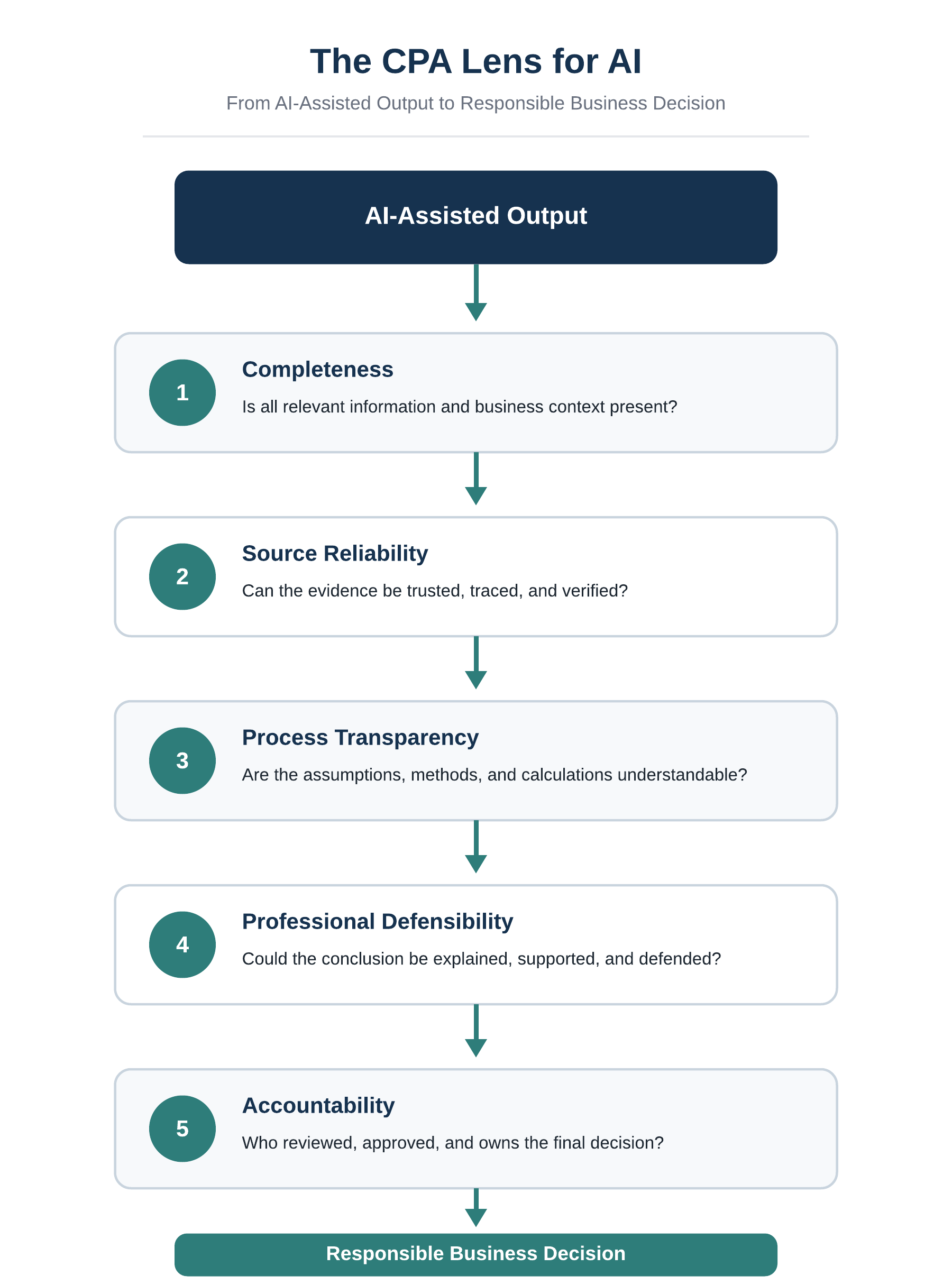
1. Is the information complete?
What may be missing from the data, document, or business context?
Does the information cover the correct period? Are relevant amendments, exceptions, reversals, or unusual transactions included? Has the system received enough context to answer the actual business question?
AI may still produce an answer when information is missing. The absence of a critical fact does not always stop the output. It may simply make the output incomplete.
2. Can I rely on the source?
Is the information current, authoritative, relevant, and appropriate for the decision?
An accounting conclusion should be traced to applicable guidance and the facts of the situation. A financial analysis should connect to approved underlying records. Research should distinguish primary evidence from secondary commentary and unsupported inference.
The quality of the output depends heavily on the quality of the evidence supporting it.
3. Do I understand how the answer was produced?
What assumptions, calculations, classifications, or exclusions shaped the result?
I do not necessarily need to understand every technical detail behind a model. But I need enough transparency to evaluate the work.
What population was analyzed? How were exceptions handled? Can significant calculations be recreated? Did the system introduce an assumption that was never approved?
4. Would I defend the conclusion in front of an audit committee?
This is my test of professional defensibility.
Could I explain the evidence? Could I describe the method? Have important limitations been disclosed? Is the level of documentation appropriate for the significance of the decision?
Not every use of AI requires the same level of scrutiny. Brainstorming a title is not equivalent to supporting a financial reporting conclusion.
The depth of review should rise with the consequence of the decision.
5. Who remains accountable?
Who reviewed the work? Who approved its use? Does that person have the necessary knowledge and authority?
AI may participate in the process. Responsibility for the outcome remains human.
The complete CPA Lens is available as Practice Guide No. 001 so professionals can apply these questions to their own AI-assisted work without turning this article into a technical checklist.
My COSO background changed the questions I asked
My work in internal controls also influenced how I interpreted what I was learning.
After completing the COSO Internal Control Certificate Program, I naturally began looking beyond the accuracy of one response and thinking about the process surrounding it.
- What information can the AI access?
- Which systems, folders, databases, or contracts should be available to it?
- Who is authorized to use the tool?
- How are changes approved?
- What documentation should be retained?
- How are exceptions escalated?
- Who reviews the result?
Those are not only technology questions. They are governance questions.
I began to see that AI does not remove the need for internal controls. It creates new processes, new pathways for information, and therefore new risks that controls must address.
That instinct is also consistent with current resources from COSO and NIST, which approach responsible AI as a process and lifecycle issue rather than only a final-output review. [2] [3]
At the same time, I do not want this first reflection to become an article about governance frameworks. Access controls, model oversight, documentation, and formal AI governance each deserve deeper treatment in future articles.
The personal lesson for me was simpler:
The more capable AI becomes, the more intentional organizations must become about responsibility.
Human review at the end is important, but it cannot correct every weakness created earlier in the process.
A reviewer may not know that confidential information was entered into an unapproved tool. They may not realize a relevant document was missing. They may not see that data was changed before the analysis began.
Responsible AI use therefore starts before the final answer appears.
What this could mean for finance professionals
What excites me most is not the idea of AI performing every part of accounting work.
It is the possibility of reducing the amount of time professionals spend on repetitive activities that do not fully use their training.
Finance teams spend countless hours gathering information, organizing documents, preparing recurring reports, creating first drafts, researching routine questions, and completing administrative steps around analysis.
AI may help accelerate much of that work.
That could create more time for professionals to investigate unusual results, improve processes, communicate with leadership, strengthen controls, advise the business, and apply judgment to situations where the answer is not obvious.
The value of a CPA has never come only from moving information between systems or preparing a spreadsheet quickly.
It also comes from understanding what the numbers represent.
It comes from noticing what does not make sense.
It comes from recognizing when evidence is insufficient.
It comes from connecting technical requirements to real business circumstances.
And it comes from accepting responsibility for a conclusion that other people may rely upon.
AI can support that work. It cannot relieve us of the obligation to think.
What changed for me
The first week of the program did more than introduce me to a new set of tools.
It changed the way I viewed the relationship between technology and professional expertise.
I began the week wondering whether AI would reduce the need for accountants.
I ended it believing that AI may make the most human parts of accounting more visible.
The ability to gather information quickly will matter.
The ability to evaluate it will matter more.
The ability to generate a polished analysis will matter.
The ability to determine whether that analysis is supported, complete, and appropriate for the decision will matter more.
The ability to automate a process will matter.
The ability to design that process responsibly will matter more.
That is why I believe CPAs have an important role in the age of AI.
Our training encourages us to ask what supports a conclusion, what might be missing, how a process should be controlled, and who remains accountable.
Those habits are not barriers to innovation.
They are part of what can make innovation dependable.
Key takeaways
- AI can increase productivity without eliminating the need for expertise.
- A confident and polished response may still require significant verification.
- Professional prompting is closely connected to clear work instructions and process design.
- The level of review should increase with the significance of the decision.
Most importantly:
Thinking like a CPA in the age of AI means understanding that technology can accelerate our work, but professional judgment, evidence, accountability, and ethics remain human responsibilities. AI should enhance our ability to think - not replace the thinking itself.
Questions I’m still exploring
- How should organizations document significant work prepared with AI assistance?
- What level of human review is appropriate for different accounting and finance applications?
- How should management distinguish between low-risk productivity uses and high-risk decision support?
- When should an AI-generated calculation be independently reproduced?
- What evidence should be retained when AI contributes to a financial analysis?
- How should responsibility be divided among finance, technology, risk, legal, and operational teams?
- Which accounting activities benefit most from AI augmentation?
- Which decisions should remain primarily under direct human judgment?
These questions do not have simple answers.
That is precisely why accounting and finance professionals should help shape the conversation as AI moves from experimentation into everyday business processes.
The more capable AI becomes, the more valuable professional judgment becomes.
Companion practical resource
CPA Insight
AI can produce an answer. Professional judgment determines whether that answer should become a decision.
Selected sources and further reading
- OpenAI, “Tokenizer.” Explains that language models process text as tokens and learn statistical relationships used to produce the next token in a sequence.
- Committee of Sponsoring Organizations of the Treadway Commission (COSO), “Achieving Effective Internal Control Over Generative AI.” A COSO-aligned resource addressing the risks and opportunities associated with generative AI.
- National Institute of Standards and Technology, “Artificial Intelligence Risk Management Framework: Generative Artificial Intelligence Profile,” NIST AI 600-1. A voluntary cross-sector resource for incorporating trustworthiness considerations into the design, development, use, and evaluation of generative AI systems.
Learning note
This article reflects my personal understanding and practical interpretation of concepts explored through professional education and my experience in accounting and finance. It is not an official publication of, or endorsed by, any educational institution, certification provider, professional association, or standard-setting organization. It is intended for general educational purposes and is not accounting, legal, audit, tax, or other professional advice.
Continue the Conversation
This article is the beginning of a broader exploration of how accounting and finance professionals can use emerging technologies while preserving professional judgment, evidence, internal controls, and accountability.
Prompt Engineering Is Process Design
How finance professionals can design clearer, more reliable AI-assisted work instructions.
AI and Internal Controls
How artificial intelligence changes the risks, responsibilities, and controls surrounding financial processes.
AI Governance Through a CPA Lens
What responsible AI adoption may require from finance, risk, technology, and organizational leadership.